James Hardie Junior ADU Conversion: The Los Angeles Owner’s Guide
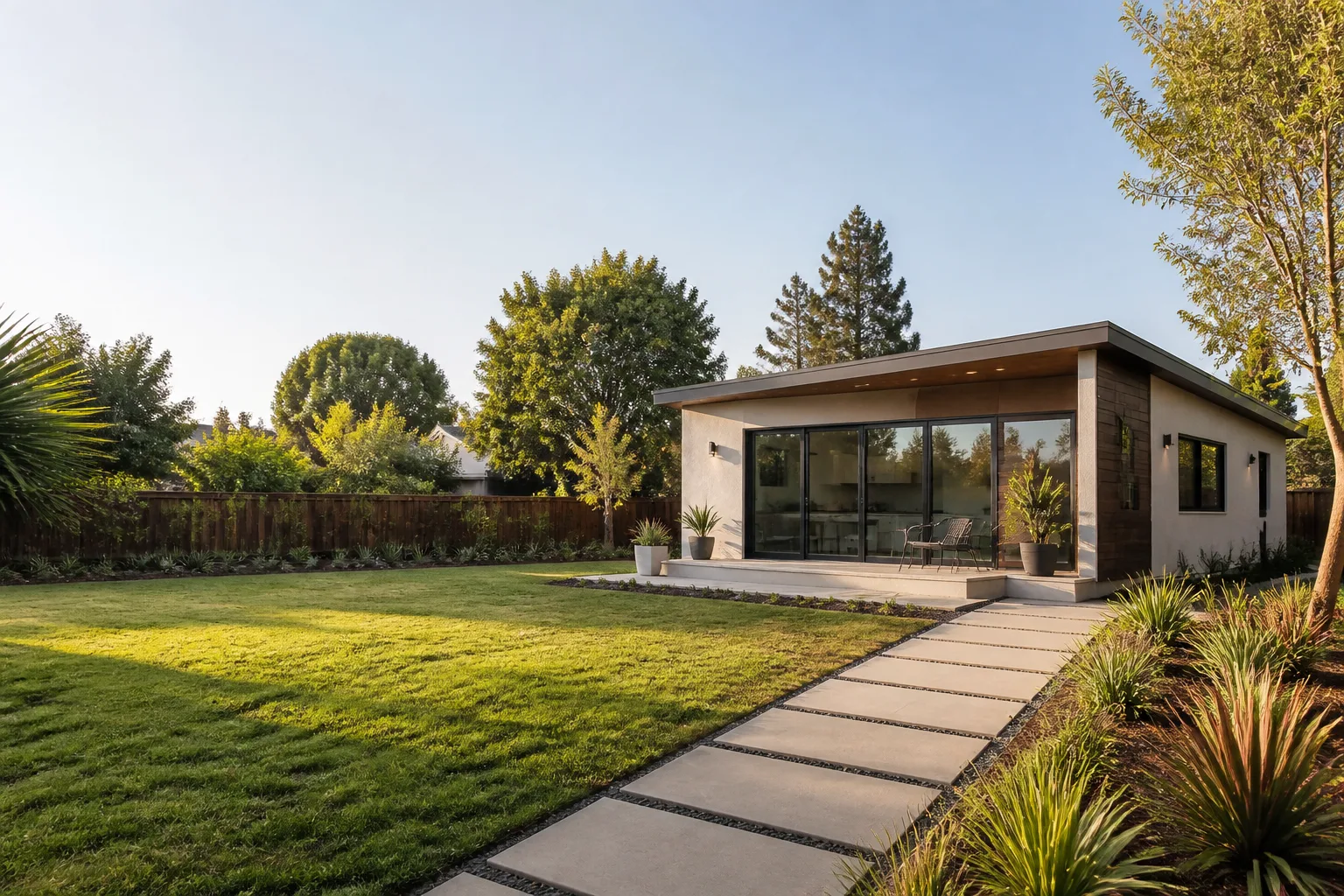
James Hardie Junior ADU conversion in Los Angeles typically runs $85,000 to $145,000 for a permitted, turnkey build, depending on lot access, foundation work, and utility tie-ins. We stock HardiePlank lap siding, HardiePanel vertical siding, HardieTrim boards, and HardieBacker board on our trucks, so if conversion work has exposed a failed or failing exterior section, we can match the existing product before it spreads. Most Los Angeles owners discover an issue the same way: a corner of HardieTrim has swelled at the cut edge, a bottom course of lap siding has wicked moisture from grade contact, or the original installer caulked a joint that James Hardie’s spec says should have been flashed, not sealed.
We are an independent Los Angeles ADU contractor, not a James Hardie dealer or affiliate. That matters because our recommendation is based on what holds up on a Los Angeles lot, not what moves a product line.
Which James Hardie Models This Applies To
James Hardie makes one fiber-cement material system and cuts it into different profiles, so the compatibility question is less about “models” and more about profile, thickness, and exposure. The products we see on Los Angeles junior ADU conversions are HardiePlank lap siding in 5/16″ thickness, HardiePanel vertical siding in 7/16″, HardieTrim 4/4 and 5/4 boards, and HardieSoffit for eave work. If the failed section is lap siding, you need to match both the width (5.25″, 6.25″, 7.25″, or 8.25″) and the exposure (the visible face after overlap). A 6.25″ plank installed at a 5″ exposure is not a match for the same plank at a different exposure the shadow lines will read differently on the wall.
The OEM versus aftermarket decision is straightforward with James Hardie: there is no aftermarket equivalent. Fiber cement is a proprietary slurry, and a generic cement board from a lumberyard will not match the grain pattern, texture, or paint finish of HardiePlank. We use genuine James Hardie product on James Hardie repairs, period. The one place we will substitute is flashing and sealant, where we prefer stainless steel flashing and a high-quality polyurethane sealant over anything sold as part of a siding kit.
One compatibility gotcha that matters in Los Angeles: color. James Hardie’s prefinished ColorPlus product has a deeper baked-on finish than a primed-only board that got painted on site after install. If your junior ADU was built with ColorPlus siding, that is a true factory match issue, not a paint match you solve at a paint store. We order the same ColorPlus SKU rather than trying to feather in a primed board and custom paint it.
Signs Your James Hardie Junior ADU Conversion Is Failing
- Swelling or delamination at a cut edge. Fiber cement is dimensionally stable until water sits on an unsealed edge. Bottom courses near grade, or edges cut for an outlet box and not sealed, are the most common spots. Once a corner of a board raises, water gets behind the whole lap.
- Mold or dark staining at the butt joints. Where two pieces of lap siding meet mid-wall, water that gets behind one piece has nowhere to go but down. Staining at the joint tells you the flashing behind it failed or was never installed.
- Paint peeling in a straight line, not a patch. Peeling on the upper third of a lap course, in a horizontal band, usually means the board above is not lapped far enough and water is running behind it. That is an install failure, not a paint failure.
- Gaps opening between trim and siding. HardieTrim has a different expansion rate than wood trim. On Los Angeles junior ADUs we see gaps at the trim-to-siding joint after two or three hot summers, and if the joint was caulked instead of flashed, the gap is where water gets in.
- Soft spots or bubbling on HardiePanel. Vertical panel siding carries more wall load than lap, so a bubbled or soft area on a panel is more than a cosmetic issue. It points to moisture trapped in the wall cavity, which is a structural signal, not a paint signal.
Replacement Cost & What’s Included
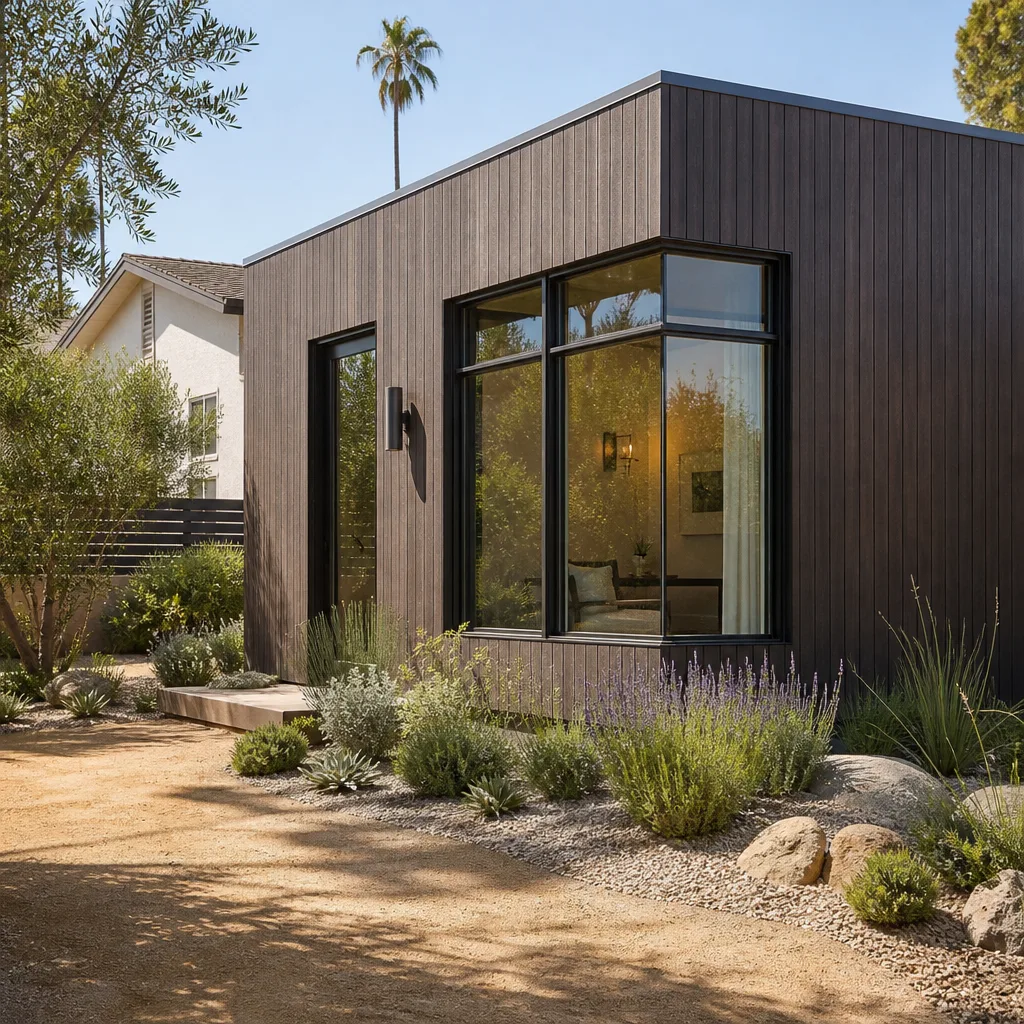
For a small, isolated James Hardie repair on a junior ADU in Los Angeles, expect $400 to $1,200 depending on the number of courses, ladder access, and whether we are matching a primed or ColorPlus finish. For conversion work that involves removing and replacing full wall sections, the siding portion of a larger job typically lands between $4,500 and $9,000 before permit fees depending on square footage, waste factor, and access. Full-scope junior ADU conversions run $85,000 to $145,000, and the siding is one line item inside that number, not a mystery markup.
Every quote we write includes parts, labor, flashing, sealant, fastener, and debris removal as separate line items. The price on the written quote is the price on the final invoice. The Garrison Standard covers workmanship for 365 days; if something fails inside that year, we come back and correct it at no charge.
DIY or Call Us?
What you can safely check yourself: look at any cut edges within six inches of grade, confirm downspouts are not dumping onto the wall, and photograph any staining before it gets worse. What we would not do yourself is remove fiber-cement boards below a window or at a corner. HardiePlank is heavy, brittle at the edges, and once a lap is pulled, the water barrier behind it is exposed for any rain between now and whenever the repair gets finished. If the section is high on the wall or behind a downspout, the ladder work alone is not worth it.
James Hardie siding repair is not high-tension like a garage spring, but it is not a paint-and-caulk job either. A wrong repair traps water inside the wall and turns a $600 fix into a $6,000 sheathing replacement. Put it in writing, pull the permit, do the work. Call (213) 732-1415 and we will put eyes on it.
FAQs
HardiePlank and HardiePanel carry a 30-year limited manufacturer warranty, but the real lifespan on a Los Angeles lot depends on installation details like edge sealing, flashing, and ground clearance. We see properly installed James Hardie units in Los Angeles pass 20 years with nothing but a repaint, while poorly flashed sections fail inside five years.
An isolated failed course or trim piece can be repaired by cutting out the affected board and installing a new one, as long as the wall sheathing and water barrier behind it are sound. If the damage traces to a systematic issue like missing flashing at every butt joint, the repair scope grows. Call (213) 732-1415 and we will look at it in person.
A single-course repair takes half a day for removal, flashing, and install; a full wall or full junior ADU siding replacement runs three to seven days depending on height, access, and ColorPlus lead time. We schedule the repair once and show up on the day we said we would.
We stock HardiePlank, HardiePanel, HardieTrim, and HardieSoffit on our trucks in common Los Angeles profiles, and we order ColorPlus SKUs same-week when the job needs a finish-matched board. Reed Calloway has been building ADUs in Los Angeles for going on twelve years, and part of that is knowing what to keep on the truck versus what to special-order. Call (213) 732-1415 for a free estimate.
Written by Reed Calloway, Owner, Fielding ADU Los Angeles at Fielding ADU Los Angeles, serving Los Angeles and nearby areas.