Last updated October 15, 2026
DIY vs Professional ADU: The Los Angeles Homeowner’s Decision Guide
In Los Angeles, the DIY-versus-professional ADU question is largely settled by the permit process itself. Owner-builder permits are available to any homeowner, but they carry consequences most people don’t learn about until they try to sell or refinance the property. An LA homeowner who pulls an owner-builder permit to save money on labor is legally required to disclose that status to any buyer for three years after completion. Many title companies and lenders treat owner-built ADUs as a material risk, which affects the value of the asset the owner just spent $200,000 to build. This guide walks through what the owner-builder route actually requires in Los Angeles, what it costs, where it goes wrong, and when it makes sense; for a step-by-step guide on hiring an ADU contractor in Los Angeles, see our companion resource.
Quick Answer
For most Los Angeles homeowners, hiring a licensed general contractor for an ADU is the lower-risk choice. The owner-builder permit saves money on labor markup in the short term but attaches a three-year disclosure requirement to the property that title companies and lenders flag during sales and refinances. DIY makes sense for a narrow set of conditions: simple detached ADUs on flat lots with no grading issues, where the owner has construction experience and the time to manage licensed subcontractors directly.
Table of Contents
- What an Owner-Builder Permit Actually Allows in California
- The Resale and Refinance Consequences of an Owner-Built ADU
- Which Parts of an ADU You Can Legally Self-Perform
- Real Cost Comparison: DIY with Subs vs. General Contractor
- When DIY Makes Sense in Los Angeles
- When DIY Reliably Fails in Los Angeles
- Los Angeles Inspection Reality: What the City Actually Checks
- Common Mistakes to Avoid
- When to Call a Professional
- Frequently Asked Questions
- The Bottom Line
What an Owner-Builder Permit Actually Allows in California
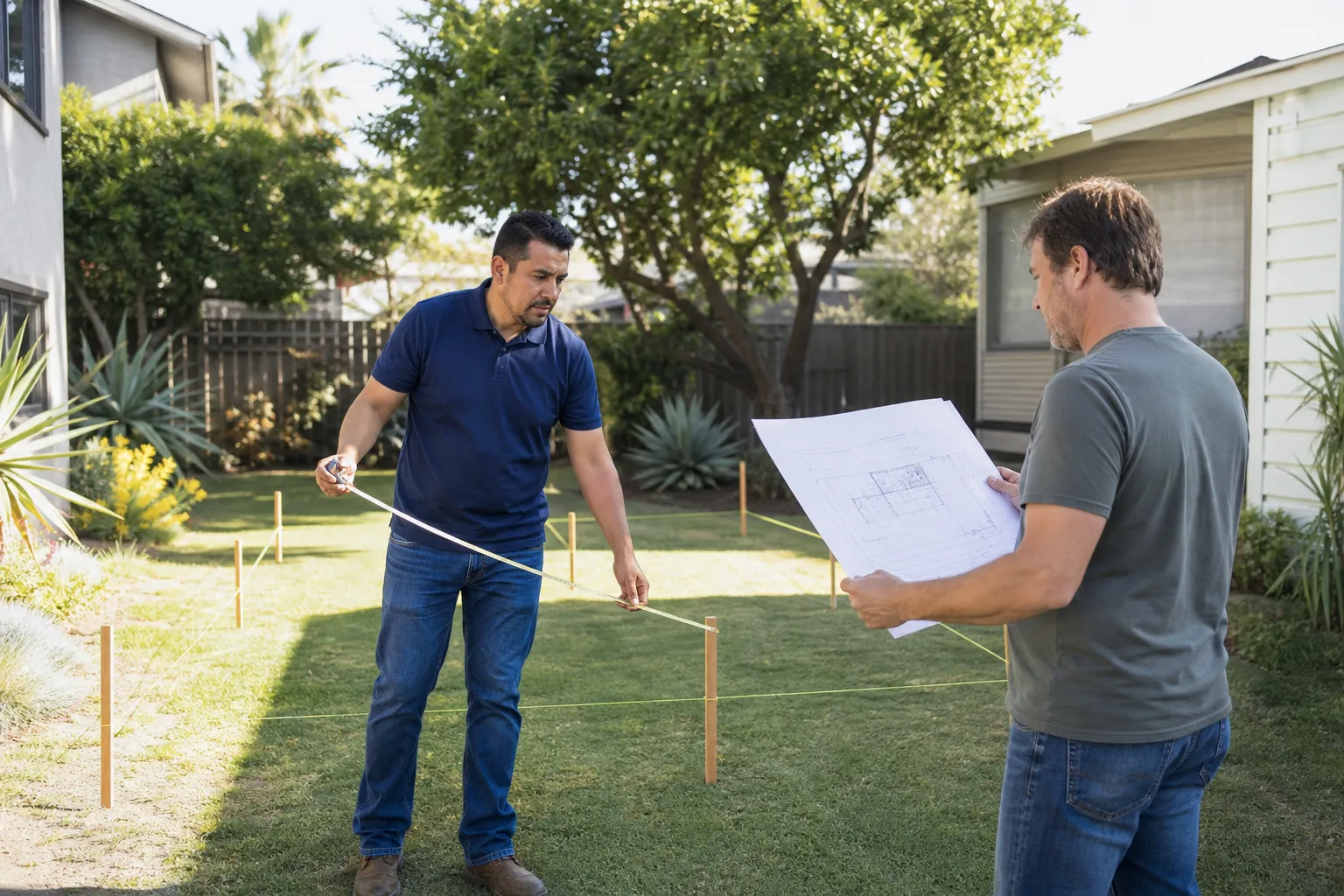
An owner-builder permit in Los Angeles lets a homeowner act as their own general contractor on a residential construction project. The legal basis is the California Business and Professions Code, which exempts a property owner from the contractor’s license requirement when the work is on their own residence and they either do the work themselves or hire licensed subcontractors. That exemption sounds broader than it is.
What the owner-builder permit actually assigns to you, the homeowner:
- Full legal liability for the construction site. If a subcontractor gets injured on your property, the claim lands on your homeowner’s insurance policy. A licensed general contractor carries workers’ compensation insurance that shields the owner from those claims.
- Responsibility for scheduling and sequencing inspections. The Los Angeles Department of Building and Safety (LADBS) requires inspections at specific stages: foundation, framing, rough electrical, rough plumbing, insulation, and final. Missing one means rework.
- Direct liability for construction defects. If the ADU develops foundation cracks or a roof leak three years after completion, the homeowner who acted as owner-builder has no contractor to call. The California statute of repose for construction defects is 10 years, but that avenue only works if a licensed contractor did the work.
- Payroll and tax obligations for any day labor you hire. Hiring unlicensed workers to pour concrete or hang drywall shifts the risk to you, including workers’ compensation exposure and potential Labor Commissioner wage claims.
The owner-builder route is legal and legitimate. But it works best for someone who understands construction sequencing, knows how to read plans, and has the time to be on site during every inspection. In our experience working on ADUs across Los Angeles neighborhoods including Van Nuys, West Adams, and Eagle Rock, the homeowners who succeed as owner-builders are almost always people with prior construction or adjacent trade experience; for ongoing upkeep tips, see our seasonal ADU care guide for Los Angeles homeowners. Everyone else ends up managing a project they don’t have the training to manage, often while holding down a full-time job.
The Resale and Refinance Consequences of an Owner-Built ADU
Here’s the part most Los Angeles homeowners don’t see coming. California Civil Code Section 1102 requires sellers to disclose, on the statutory Real Estate Transfer Disclosure Statement, whether any structural additions were constructed under an owner-builder permit. That disclosure requirement runs for three years after the completion of the work. It follows the property, not the owner. If you sell within that window, the buyer will see the owner-builder status in writing.
Why this matters to lenders and title companies:
- Construction quality verification is harder. A licensed contractor’s work is backed by the California Contractors State License Board. An owner-built structure has no such backstop. Lenders frequently ask for a third-party structural inspection before approving a loan on a property with a recent owner-built ADU.
- Construction defect liability is unclear. If the ADU has a framing error or waterproofing failure, the buyer has no contractor to pursue. Some title insurers decline to insure the ADU portion of the property within the three-year disclosure window, which can halt a sale entirely.
- Appraisal comparables are thinner. An ADU built to permit by a licensed contractor will have permits, inspections, and a contractor’s record attached. An owner-built ADU may have all the same paperwork but the market treats it with more skepticism. Some appraisers apply a discount to owner-built accessory dwelling units in Los Angeles, citing uncertain build quality.
- Refinance complications are real. A homeowner who built an ADU under an owner-builder permit and then tries to refinance two years later may find the lender requires a structural engineer’s report, a full permit history pull, and in some cases a Conditional Use Permit verification. These add cost and delay.
The $200,000 ADU you built to add value can become a $180,000 ADU at appraisal because the lender applied a risk premium to the owner-builder status. That math matters. What you save on general contractor markup can be wiped out by a single refinance or sale complication inside the disclosure window.
This is a core reason why ADU builders in Los Angeles who work under a licensed general contractor carry a real advantage at resale time. The contractor’s license number attaches to the permit, the builder carries liability insurance, and the buyer’s lender sees a standard construction history.
Which Parts of an ADU You Can Legally Self-Perform
A determined owner-builder in Los Angeles can legally self-perform several phases of ADU construction after rough inspections pass. But the word “legally” does heavy lifting here. California law is clear about which trades require a licensed contractor regardless of whether the permit is owner-builder or contractor-pulled.
Here’s the breakdown of what a homeowner can do with their own hands:
- Painting, interior and exterior. No license required. This is the most common owner-builder labor contribution and carries the least risk.
- Flooring installation. Laminate, vinyl plank, and tile can be self-installed. Carpet too. No license required.
- Finish carpentry. Baseboards, door casing, and trim work fall outside licensed trade requirements.
- Demolition of non-structural interior elements. Pulling out old cabinets and removing drywall from non-load-bearing walls is legal for the owner to do. Structural demolition requires an engineer’s sign-off.
- Landscaping and site cleanup. Grading for drainage around the ADU, planting, and hardscape are all owner-permitted work.
- Cabinet assembly and installation. Modular and prefab cabinet systems are within the owner-builder scope.
What you cannot do yourself, no matter how the permit reads:
- Electrical work. California law requires a C-10 licensed electrical contractor for any installation, modification, or repair of wiring. The owner-builder exemption does not extend to electrical. No exceptions.
- Plumbing. A C-36 licensed plumbing contractor is required for supply lines, drain lines, gas lines, and fixture installation.
- HVAC installation. A C-20 license is required for heating and air conditioning systems, including mini-split installations.
- Roofing. A C-39 roofing contractor is required for the roof assembly.
- Structural framing. While the law technically allows an owner to frame, LADBS will require the plans to be stamped by a California-licensed engineer. If the framing deviates from the plans, the inspector can fail the inspection and require an engineer’s revision. In practice, most owner-builders hire a framing crew.
The realistic owner-builder path in Los Angeles is: you act as the general contractor, hire licensed subs for electrical, plumbing, HVAC, and roofing, and do the finish work yourself. That’s the model that works. The model that doesn’t is trying to do everything with day labor and YouTube tutorials, because the inspections will catch it.
Real Cost Comparison: DIY with Subs vs. General Contractor
The honest math on ADU costs in Los Angeles is not flattering to the DIY route as a pure savings play. A general contractor’s markup in the LA market typically runs 15 to 25 percent of total project cost. On a $250,000 detached ADU, that’s $37,500 to $62,500 in markup. The owner-builder saves that amount in theory. In practice, the savings shrink fast.
Here’s a line-item comparison for a standard 500-square-foot one-bedroom detached ADU in Los Angeles, assuming mid-range finishes:
- Architectural and engineering plans: $8,000 to $14,000 whether you’re owner-builder or using a GC. No savings either way.
- LADBS permit fees: $4,000 to $8,000 depending on valuation and school fees. The permit fee is set by valuation, not by who pulled the permit. No savings.
- Foundation and concrete: $18,000 to $28,000 with a licensed concrete sub. A general contractor may get better sub pricing through volume relationships, which can offset 3 to 5 percent of DIY savings.
- Framing labor: $22,000 to $35,000. A framer charges owner-builders the same as they charge GCs, sometimes more because the owner-builder represents one job while the GC represents repeat work.
- Electrical (C-10): $12,000 to $18,000. No owner-builder discount. Electrical contractors charge market rate regardless of who pulls the permit.
- Plumbing (C-36): $10,000 to $16,000. Same situation. No discount.
- HVAC mini-split (C-20): $6,000 to $10,000. Same.
- Roofing (C-39): $8,000 to $14,000. Same.
- Drywall and insulation: $10,000 to $15,000. An owner-builder can save $8,000 to $10,000 by hanging and finishing drywall themselves, but drywall finishing is a skill that shows every flaw under paint.
- Finish work (flooring, trim, paint, cabinets): $18,000 to $28,000. This is the real owner-builder savings zone. Self-performing all finish work can save $12,000 to $18,000.
Add it up and the realistic owner-builder savings on a $250,000 ADU is $12,000 to $20,000, not the $50,000 a homeowner might expect. That savings represents the general contractor’s markup minus the money lost to higher sub pricing, your own time at 20 to 30 hours a week for 6 to 9 months, and the cost of any mistakes that require rework. At prevailing LA wages, a homeowner who spends 20 hours a week managing the build over 8 months is investing 640 hours of their own labor. At a conservative $50 per hour value, that’s $32,000 in opportunity cost, which more than erases the savings.
For a garage conversion in Los Angeles, the math is tighter. Garage conversions run $80,000 to $150,000 and involve fewer separate trades, so the owner-builder savings typically lands between $8,000 and $15,000. But the same disclosure and liability rules apply.
When DIY Makes Sense in Los Angeles
We’re not anti-DIY. There are specific Los Angeles project conditions where the owner-builder route can work and save real money. They just happen to be a minority of ADU projects.
Conditions where DIY or owner-builder makes sense:
- Your lot is flat and the ADU is detached. No hillside grading, no retaining walls, no soil reports requiring special foundation engineering. Flat lots in neighborhoods like Mar Vista, Westchester, and parts of the San Fernando Valley simplify the build enough that a competent owner-builder can manage the sequence.
- You’re using a prefab or modular ADU platform. Companies like Abodu, Cover, Dvele, and Plant Prefab deliver factory-built modules that require a simplified site foundation and utility hookup. The prefab route reduces the number of on-site trades and can work well under owner-builder because the manufacturer handles much of the complexity.
- You have construction or adjacent trade experience. If you’ve worked as a framer, finish carpenter, or project manager in construction, you understand sequencing, inspection timing, and sub coordination. That experience is worth more than any cost table.
- You can be on site every day. LADBS inspections are scheduled by phone or online, and the window can be a four-hour block. If your job is flexible enough to meet inspectors on their schedule, owner-builder is viable. If you work a 9-to-5 in an office, it’s not.
- You plan to hold the property long-term. If you’re not selling or refinancing within the three-year disclosure window, the resale consequence is neutralized. A homeowner who builds an ADU at 40 and stays in the house until 65 never triggers the disclosure conversation.
One nuance worth naming: prefab platforms change the owner-builder math in Los Angeles. Because the structure is built in a factory with its own quality control and engineering, the on-site risk is lower. A homeowner using a prefab ADU from a manufacturer like Boxabl or Plant Prefab can reasonably act as owner-builder for the site work and hookups while relying on the factory’s engineering for the structure itself. That’s a legitimate middle path.
When DIY Reliably Fails in Los Angeles
The conditions where owner-builder goes wrong are more common than the ones where it works. We see the same patterns repeat across Los Angeles ADU projects.
Conditions where DIY reliably fails:
- Hillside lots or lots with significant grade change. Properties in Mount Washington, Echo Park, Silver Lake, and the canyon neighborhoods require grading, retaining walls, and often soils reports. The engineering complexity demands a licensed general contractor who has managed hillside builds before.
- Garage conversions with existing structural issues. Many LA garages built before 1970 have unreinforced masonry, termite damage, or foundation cracks. Converting one requires structural retrofits that an owner-builder is not equipped to evaluate. A room addition contractor in Los Angeles who has done 30 garage conversions knows what to look for. A homeowner doing it for the first time doesn’t.
- ADUs attached to the primary residence. Attached ADUs share walls, rooflines, and sometimes plumbing with the existing house. The risk of damaging the primary structure during construction is real, and the owner bears that risk directly without a contractor’s insurance.
- Projects on a tight timeline. If you’re building the ADU for a family member who is moving in by a specific date, or you need rental income to offset the construction loan, the owner-builder delay pattern will hurt. Owner-builds in Los Angeles typically run 30 to 50 percent longer than contractor-built projects because the owner is learning sequencing in real time.
- Homes in historic preservation overlay zones (HPOZ). LA has dozens of HPOZ neighborhoods, including Angelino Heights, Hancock Park, and parts of Highland Park. These have additional design review and approval requirements that add months to the permit process. An owner-builder navigating HPOZ review without experience will stall.
The honest way to think about it: owner-builder is a project management job on top of a construction job. Most people have one full-time job already. Adding a second one with inspection deadlines, sub coordination, and LADBS paperwork is how ADU projects end up taking 18 months instead of 9.
Los Angeles Inspection Reality: What the City Actually Checks
LADBS inspections are not a rubber stamp. The inspectors are thorough, and the inspection sequence for an ADU in Los Angeles follows a strict order. Here’s what the city actually checks at each stage:
- Foundation inspection. The inspector verifies rebar placement, footing depth, and anchor bolt spacing against the engineered plans. If the rebar is placed wrong, the concrete pour doesn’t happen. Fixing it means cutting out concrete or starting over on the rebar cage.
- Framing inspection. The inspector checks stud spacing, header sizes, shear wall nailing patterns, and hold-down locations. Los Angeles is in seismic zone D, which means the shear wall requirements are strict. A framing error here means the inspector writes a correction notice and you’re scheduling a follow-up inspection two weeks out.
- Rough electrical inspection. The C-10 electrician’s work is checked for box fill, wire gauge, GFCI protection, and grounding. The inspector will open junction boxes and check connections.
- Rough plumbing inspection. The C-36 plumber’s supply and drain lines are pressure-tested and inspected. The inspector checks pipe slope, vent routing, and gas line sizing.
- Insulation inspection. The inspector verifies R-values, vapor barrier placement, and air sealing. Los Angeles requires R-13 wall insulation and R-30 ceiling insulation minimum for most ADUs.
- Final inspection. Everything is checked: electrical fixtures, plumbing fixtures, HVAC operation, smoke and carbon monoxide detectors, egress windows, and final grading for drainage.
The owner-builder who misses an inspection sequence or schedules out of order gets a correction notice and a delay. A general contractor who builds ADUs in Los Angeles every week knows the inspectors, knows what they flag, and schedules inspections in the right order without thinking about it. That knowledge is worth real money in reduced delay time.
Common Mistakes to Avoid
- Pulling an owner-builder permit without reading the disclosure rules. California Civil Code 1102 requires the three-year disclosure. Not knowing about it doesn’t exempt you from it. Read the law before you decide.
- Hiring unlicensed day labor for foundation or framing work. The workers’ compensation risk and the quality risk both sit on you. If an unlicensed worker is injured on your ADU site, your homeowner’s policy may deny the claim because the work was outside the policy’s normal scope.
- Skipping the soils report on a hillside lot. Los Angeles hillside ADUs require a soils report for grading and foundation design. Skipping it means the foundation gets engineered without knowing what’s underneath it, and LADBS will not approve the permit without it anyway.
- Assuming prefab means no permits. Prefab ADUs from manufacturers like Boxabl, Plant Prefab, and Cover still require LADBS permits, site inspections, and utility hookups. The factory build reduces on-site labor but does not eliminate the permit process.
- Underestimating the time commitment. Owner-builders in Los Angeles report spending 20 to 30 hours a week managing their ADU project. That’s a part-time job on top of everything else. If you can’t commit that time for 6 to 9 months, the project will stall.
- Not checking whether your property is in an HPOZ or coastal zone. Both add review layers and time. Coastal zone properties require Coastal Commission review in addition to LADBS permits. HPOZ properties require design review that can take months.
- Treating the inspection schedule as flexible. LADBS inspectors give a four-hour window. Miss the window and you’re rescheduling, often one to two weeks out. Each missed inspection adds real time to the project.
When to Call a Professional
Call a licensed general contractor when the project involves hillside work, attached construction, structural retrofits, HPOZ review, or a timeline that matters. Call a professional when the owner-builder liability exposure outweighs the savings, which it does for most people on projects over $150,000. Call a professional when you want the permit to reflect a licensed contractor so the resale conversation is simple instead of complicated. If you’re weighing the decision, Fielding ADU Los Angeles home is where we walk through the cost breakdown honestly, including whether owner-builder makes sense for your specific lot. We give written prices before any work starts, and every project is covered by our 365-Day Done Right Promise in writing. Call (213) 732-1415 for a free estimate.
Frequently Asked Questions
Yes, you can pull an owner-builder permit and act as your own general contractor in Los Angeles. The permit legally allows you to hire licensed subcontractors and self-perform finish work. But California law requires licensed C-10 electricians, C-36 plumbers, C-20 HVAC contractors, and C-39 roofers regardless of who pulls the permit. The owner-builder exemption does not let you perform those trades yourself.
Realistic owner-builder savings on a $250,000 detached ADU in Los Angeles run $12,000 to $20,000, not the $50,000 many homeowners expect. The savings come from self-performing finish work and avoiding the general contractor’s 15 to 25 percent markup. But much of that markup is offset by higher sub pricing for one-off projects, your own time investment of 20 to 30 hours per week, and the cost of any rework from sequencing errors. Call (213) 732-1415 for an exact cost breakdown on your project.
It can. California law requires a three-year owner-builder disclosure when selling, and during that window, title companies and lenders may require additional structural inspections or apply an appraisal discount. After the three-year window, the stigma generally fades. If you plan to sell or refinance within three years of completion, a licensed contractor’s permit carries cleaner value.
You can legally self-perform painting, flooring installation, finish carpentry, non-structural demolition, cabinet installation, and landscaping. You cannot legally perform electrical, plumbing, HVAC, or roofing work yourself. Those require licensed contractors in California regardless of the permit type.
In Los Angeles, owner-built ADUs typically take 30 to 50 percent longer than contractor-built projects. A contractor-built 500-square-foot ADU runs 6 to 9 months from permit to final inspection. The same project under owner-builder commonly runs 10 to 14 months because of scheduling delays, inspection reschedules, and the owner learning construction sequencing in real time.
Yes. Prefab and modular platforms like Boxabl, Cover, and Plant Prefab shift much of the construction complexity to the factory, which reduces the on-site risk for an owner-builder. The factory handles structural engineering and quality control, while the owner-builder manages site preparation, foundation, and utility hookups. It’s a legitimate way to reduce both cost and risk compared to a fully site-built owner-builder project. The Garrison Standard applies to prefab work the same way it applies to conventional builds: written price before work starts, and a one-year written guarantee on the finished ADU.
Inspection scheduling is the most common stall point. LADBS inspectors give four-hour windows, and owner-builders who work full-time jobs miss those windows. Each missed inspection adds one to two weeks to the timeline. A licensed general contractor who builds ADUs in Los Angeles every week knows the inspectors and schedules inspections without the learning curve.
The Bottom Line
The DIY versus professional ADU decision in Los Angeles comes down to three factors: your construction experience, your timeline, and your plans for the property. If you have trade experience, a flat lot, flexible time, and no plans to sell within three years, owner-builder can save $12,000 to $20,000. If any of those conditions is missing, the savings evaporate and the liability arrives. A licensed general contractor pulls the permit under their license, carries the insurance, manages the inspections, and leaves the property with a clean title history-our Room Addition Contractor Maintenance Checklist for Los Angeles Homeowners covers what to verify. That’s what the Garrison Standard means in plain terms: written price before work starts, work done by the book, and a one-year written guarantee that survives the final inspection. Call (213) 732-1415 to talk through your specific lot and budget.
Written by Reed Calloway, Owner at Fielding ADU Los Angeles, serving Los Angeles since 2006.