Last updated October 15, 2026
How to Hire a ADU Contractor in Los Angeles: A Step-by-Step Guide
Los Angeles is in the middle of the largest accessory dwelling unit build-out in the country. The city issued more ADU permits in 2023 than any municipality in California, and that pace has not let up. But here is the number that should get your attention: the Contractors State License Board logged over 14,000 consumer complaints against California contractors in a recent two-year period. A large share of those complaints started the same way: a homeowner took the lowest bid, signed a thin contract, and ended up with a half-finished structure, a lien on the property, or a permit board that stayed blank for months. This guide walks through how to hire an ADU contractor in Los Angeles so that you are not the next complaint, and you can find more guides & resources on our blog. It covers the documents that protect you, the contract language that separates professionals from bid-and-flip operators, and the interview questions that expose who has actually pulled an LA permit and who is learning on your dime.
Quick Answer
Hiring an ADU contractor in Los Angeles comes down to verification, contract review, and payment structure. Confirm the license, bond, and workers’ compensation certificate directly with the CSLB before signing anything, require a written price and a permit-pull clause in the contract, and never let payments run ahead of completed work value. A contractor who passes all three checks is rare in LA; a contractor who resists any one of them is a risk you should not take.
Table of Contents
- Step 1: Verify the License, Bond, and Workers’ Comp – and Understand What Each Protects
- Step 2: Recognize the Red Flags That Bid-and-Flip Operators Share
- Step 3: Interview Questions That Separate LA ADU Specialists from Generalists
- Step 4: The Contract Terms You Must See in Writing
- Step 5: Structure Payments So You Never Owe More Than the Work Is Worth
- Step 6: Why Permit-Pull Responsibility Is a Non-Negotiable
- Step 7: Los Angeles-Specific Rules, Fees, and Timelines
- Common Mistakes to Avoid
- When to Call a Professional
- Frequently Asked Questions
Step 1: Verify the License, Bond, and Workers’ Comp – and Understand What Each Protects
Before you discuss ADU plans, finishes, or timelines, pull the contractor’s file. You can do this in under ten minutes on the Contractors State License Board website. Type in the name or license number and you get a screen showing license status, issue date, bond amount, workers’ compensation status, and any disciplinary actions. Here is what each line item actually protects you from, in plain terms.
The license number confirms the contractor is legally allowed to perform building work in California. The bond is a $25,000 guarantee for residential projects; if the contractor abandons the job or violates the law, you can file a claim against that bond. The workers’ compensation certificate matters because if a worker gets hurt on your property and the contractor does not carry coverage, the injured worker can file a claim against your homeowner’s insurance. Checking all three takes minutes. Skipping any one opens a door you do not want open.
While you are on the CSLB site, check the contractor’s history. Look for license suspensions, revocations, or complaints. A clean record is not a guarantee of good work, but a record with repeated complaints is a guarantee of something. In our experience building ADUs across Los Angeles, the contractors who cut corners on license compliance also cut corners on foundation work, framing, and waterproofing. The paperwork is the first tell.
Step 2: Recognize the Red Flags That Bid-and-Flip Operators Share
Bid-and-flip is the term for a specific Los Angeles pattern: a contractor submits a low bid to win the job, starts demolition, then issues change orders that push the final cost 30 to 50 percent above what was signed. The contractor is not incompetent; the bid was designed to be false from the start. Here are the tells that show up before you sign.
- The bid is dramatically lower than every other estimate. A $90,000 ADU bid when three other contractors quoted $140,000 to $160,000 is not a bargain; it is a plan to earn back the difference during construction. Real materials and real labor cost real money in Los Angeles.
- The contract is two pages long. A legitimate ADU contract covers scope, permit responsibility, payment schedule, change order process, lien waiver schedule, and warranty terms. Two pages cannot hold all of that, which means the contractor is leaving room to maneuver.
- The contractor asks for a large deposit before any work starts. California law caps the down payment at 10 percent of the contract price or $1,000, whichever is less, for residential work. A contractor asking for 30 or 50 percent upfront is either ignorant of the law or testing your ignorance of it.
- The contractor will not pull the permit. This is the single clearest warning sign in the ADU business, which is why Step 6 of this guide is devoted to it. When we build in Los Angeles as ADU Builders in Los Angeles, the permit is in our name, period. If a contractor tells you to pull the homeowner permit because it is cheaper or faster, walk.
- The contractor has no physical address or references you can actually visit. A P.O. box and a cell phone is a pattern. Ask for the address of a completed ADU in your Los Angeles neighborhood, then drive by it.
None of these red flags is subtle. The problem is that homeowners ignore them when the bid number is attractive. The bid number is the least reliable piece of information in the entire hiring process. Judge by the contract, the paperwork, and the references, not the bottom line.
Step 3: Interview Questions That Separate LA ADU Specialists from Generalists
Once you have verified the license and screened out the obvious red flags, sit down with the contractor and ask specific questions. The goal is not to test personality; it is to test whether the contractor has actually navigated the Los Angeles ADU process before or is practicing on your project. Here is the list we recommend.
- How many ADUs have you completed in Los Angeles in the last three years, and can I see three of them? A specialist can name addresses. A generalist will hedge. Drive by the sites; talk to the owners if possible.
- Who in your company handles the permit package, and how long did your last LA ADU permit take from submittal to issuance? In Los Angeles, the Department of Building and Safety has dedicated ADU plan checkers, but a contractor who has done this before should be able to give you a realistic window, not a vague promise.
- What is your change order process, and can I see a blank copy of the form you use? Every project changes somewhat. The question is whether the contractor has a written process for pricing and approving changes before work proceeds. If change orders are handled verbally, your first surprise is coming.
- Have you built in my specific zone, and do you know whether my lot triggers any special setback or hillside requirements? Los Angeles zoning varies block by block. Hillside lots trigger additional foundation and drainage requirements. A contractor who has built in your council district will answer with specifics; a generalist will answer with generalities.
- What is the biggest issue you have run into on an LA ADU, and how did you resolve it? This is not a trick question. Every contractor has hit a soil problem, a utility conflict, or a plan check rejection. A contractor who describes a real problem and a real solution is telling you the truth about how the job actually goes. A contractor who says “no issues, ever” is lying.
We have used these questions, or versions of them, for years across Los Angeles projects. The contractors who answer quickly and specifically are the ones we would hire. The ones who get uncomfortable are the ones who have not done the work they claim.
Step 4: The Contract Terms You Must See in Writing
A contract is not a formality; it is the document that determines what happens when something goes wrong. In Los Angeles, where ADU projects routinely run $150,000 to $350,000 before finishes, a thin contract is how homeowners lose $40,000. Before you sign, make sure these four things are spelled out in the document, not in a verbal promise.
- A written price for the full scope. The contract should list the total price, the scope of work in detail, and what is not included. This is the single most important line in the document. At Fielding ADU Builders, the price goes in writing before any work starts, every time. The number you approve on day one is the number on the final invoice. If a contractor will not put the price in writing, do not sign the contract.
- A permit-pull clause. The contract must state that the contractor is responsible for obtaining the building permit in the contractor’s name, and that work will not begin until the permit is posted. More on this in Step 6.
- A lien waiver schedule. Every time you make a payment, the contractor should provide a conditional lien release from the contractor and any subcontractors or suppliers who have worked on the project. This protects you from a situation where the contractor fails to pay a subcontractor and that subcontractor files a mechanic’s lien against your property. The contract should state that payment is contingent on receiving signed lien waivers.
- A warranty clause with a specific duration. The contract should state what the warranty covers, how long it runs, and what the contractor will do if a defect appears. Under The Garrison Standard, every ADU we build is covered in writing for 365 days; if something fails, we come back and make it right at no charge. That warranty language belongs in the contract, not in a handshake.
In our experience, these four items are present in every contract written by a contractor who intends to do the job correctly, and absent from every contract written by one who does not. Read the contract top to bottom. Ask questions about anything unclear. A legitimate contractor wants you to understand what you are signing; a bid-and-flip operator wants you to skim it.
Step 5: Structure Payments So You Never Owe More Than the Work Is Worth
Payment structure is where Los Angeles ADU homeowners lose the most money. The pattern is familiar: a large deposit up front, then early payments that outpace the work, then a contractor who stops showing up. The rule that prevents all of this is simple: your total payments at any moment should never exceed the value of the work completed at that moment. Here is how to enforce that rule in the contract.
California law already caps the initial deposit at 10 percent of the total contract price or $1,000, whichever is less. Enforcement is a different story, and the best way to enforce it is to write the payment schedule yourself. A standard schedule for a large ADU project looks like this: deposit at contract signing, a payment at foundation completion, a payment at framing completion, a payment at drywall completion, and a final payment at final inspection and punch-list completion. Each payment should be tied to an actual milestone that you can see with your own eyes, not a date on the calendar.
The milestone schedule is your leverage. If the contractor asks for a payment before the milestone is actually reached, decline. If the contractor’s total payments would exceed the value of completed work, decline. The contractor who is doing the job correctly will not object to milestone payments; the contractor who needs your money to fund another project will object immediately. That objection is information.
One more point that most guides miss: make the final payment large enough to matter. If the final payment is only 2 percent of the contract, the contractor has little incentive to finish the punch list. Ten percent is a reasonable final payment on a large ADU project. Hold it until the permit is finaled and the punch list is cleared.
Step 6: Why Permit-Pull Responsibility Is a Non-Negotiable
The question of who pulls the permit is the single most reliable signal of a contractor’s legitimacy in Los Angeles. A homeowner-pull permit is legal in California, but a contractor who asks for one is telling you something specific: they do not want their name attached to the paperwork, which means they do not want to be responsible for the inspections, the corrections, or the final approval. Here is why that matters.
When a contractor pulls the permit in their own name, the city of Los Angeles holds that contractor responsible for meeting code. Corrections go to the contractor. Inspections are scheduled by the contractor. Final approval is the contractor’s problem. If the contractor abandons the project, the permit trail leads to the contractor’s license, bond, and insurance. If the homeowner pulls the permit, every one of those responsibilities shifts to you. The contractor can walk away and leave you with a half-finished structure, an open permit, and no leverage.
The permit also protects the value of your property. An unpermitted ADU in Los Angeles cannot be legally rented, cannot be counted in a home appraisal, and will be flagged when you eventually sell. The city can require you to tear down unpermitted work at your own expense. The permit is not a bureaucratic detail; it is the difference between an asset and a liability.
When Fielding ADU Builders takes on an ADU project in Los Angeles, the permit is in our name and it gets pulled before a single nail is driven. That is the standard. If a contractor suggests that you pull the permit to save time or money, the money you save will be spent later, with interest.
Step 7: Los Angeles-Specific Rules, Fees, and Timelines
Building an ADU in Los Angeles is not the same as building one in Sacramento or San Diego. The local rules, fees, and timelines shape the project from the first plan check to the final inspection. Here is what you need to know before you sign a contract.
Los Angeles has adopted the state’s ADU-friendly building standards, but the city still imposes local zoning rules that vary by neighborhood. Garage conversions in areas served by the Rent Stabilization Ordinance may face additional tenant protections. Hillside neighborhoods like Mount Washington, Silver Lake, and parts of the Valley trigger slope analysis, drainage studies, and foundation engineering that flat-lot projects do not, which is why we also recommend our Room Addition Contractor Maintenance Checklist for Los Angeles Homeowners for related projects. Coastal zones and historic preservation overlay zones in districts like Angelino Heights or parts of San Pedro add a layer of design review. A contractor who has built in your specific neighborhood already knows these triggers; one who has not will discover them mid-project.
The cost structure also varies by build method. A conventional ADU in Los Angeles using James Hardie siding and traditional framing typically runs $180,000 to $350,000 depending on size, site conditions, and finishes. A prefab ADU from platforms like Boxabl or Plant Prefab can come in lower on the construction side but may require additional site work, utility connections, and crane access that eat into the savings. Our team at Fielding ADU Builders works with both conventional and prefab methods, and we match the method to your lot and budget rather than forcing one approach. A flat, accessible lot is a good candidate for prefab; a hillside lot is not.
Permit timelines in Los Angeles have improved, but they still test patience. A straightforward ADU plan can clear the Department of Building and Safety in three to six months in the current environment. Projects that require zoning variances or coastal review can take longer. Ask your contractor directly: how long did your last Los Angeles ADU permit take, and what held it up? A specific answer means experience. A vague one means guesswork.
School district fees also apply in Los Angeles. The LAUSD charges a development fee on new residential square footage, including ADUs over a certain size. Your contractor should be able to identify whether your project triggers the fee and how much it will add. If they look confused by the question, that is information.
For a broader look at what goes into an ADU project and how to think about the total budget, start with our Fielding ADU Los Angeles home page, which lays out the process from first call to final walkthrough.
Common Mistakes to Avoid
- Hiring the lowest bid without checking the license. The lowest bid in Los Angeles is often the bid-and-flip operator’s opening move. Check the CSLB file before you compare numbers.
- Signing a contract that does not state who pulls the permit. If the contract is silent on permit responsibility, assume the responsibility will fall on you. That is how it works.
- Paying ahead of the work. Every dollar you pay before the corresponding work is complete is a dollar you cannot recover if the contractor disappears. Use milestone payments tied to visible progress.
- Accepting verbal change orders. Changes happen on every project, but a verbal agreement is not enforceable. Require every change order in writing, with a price attached, before the work is done.
- Skipping the lien waiver. If you do not collect a conditional lien release with each payment, you may pay for the same labor twice: once to the contractor and once to the subcontractor who files a lien.
- Ignoring the warranty clause. A contract without a written warranty is a contract that covers the contractor and not you. Require a specific term and a specific remedy in writing.
- Believing that prefab means perk-free. Prefab ADUs from platforms like Boxabl or Plant Prefab still require a foundation, utility connections, and a permit in Los Angeles. The factory does not handle the site work. Your contractor should explain exactly what the prefab price includes and what it does not.
When to Call a Professional
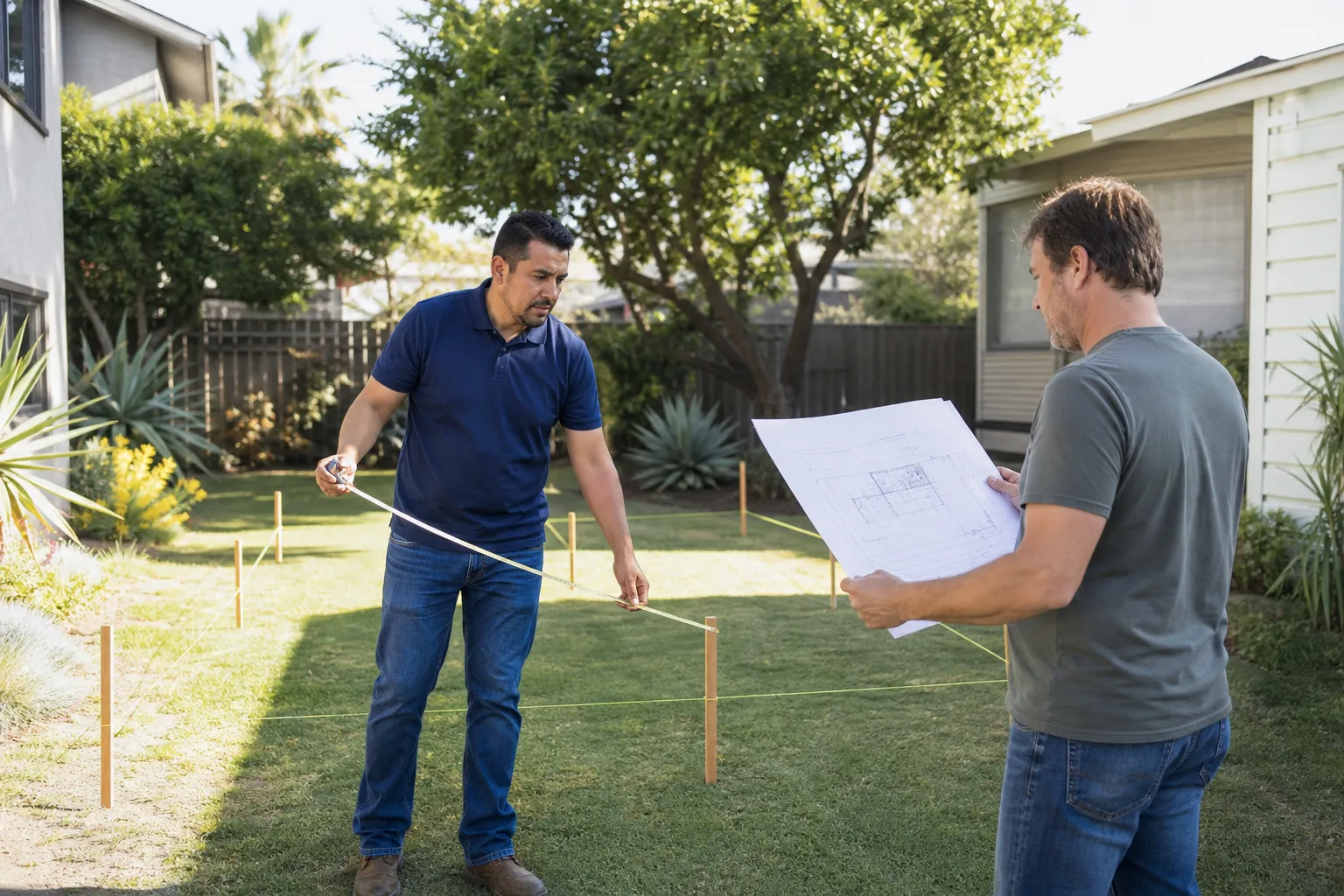
You should call an ADU contractor before you have made any irreversible decisions. The moment you are serious about an ADU, a garage conversion, or a room addition, a conversation with a contractor who has built in Los Angeles will save you from expensive assumptions about cost, zoning, and timeline, and our Seasonal ADU Care for Los Angeles: Year-Round Homeowner’s Guide can help you plan for long-term maintenance. Bring your lot address and your rough budget, and ask the questions in this guide. A legitimate contractor will answer them. If you are not sure where to start, Fielding ADU Los Angeles offers free estimates in Los Angeles – call (213) 732-1415. We will walk the lot, discuss build methods including conventional, prefab, and Tuff Shed-based structures, and put the price in writing before any work starts.
Frequently Asked Questions
A conventional ADU in Los Angeles typically runs $180,000 to $350,000 depending on size, site conditions, and finishes. A garage conversion or a prefab build can come in lower, but site work, utility connections, and LA-specific fees will affect the final number. Call (213) 732-1415 for an exact quote – estimates are free, and we put the price in writing.
In the current environment, a straightforward ADU permit in Los Angeles can clear in three to six months from submittal to issuance. Projects that require variances, hillside review, or coastal review take longer. The contractor’s permit history should give you a realistic window for your specific lot.
No. A contractor who asks you to pull the permit is shifting responsibility and liability to you. When the contractor pulls the permit in their name, the city holds them accountable for inspections, corrections, and final approval. A homeowner-pull permit is legal, but it surrenders your leverage.
California law caps the down payment at 10 percent of the contract price or $1,000, whichever is less. Any contractor asking for more is either violating the law or testing whether you know it. Both are disqualifying.
A lien waiver is a written release that protects you from a mechanic’s lien filed by a subcontractor or supplier who was not paid. You should receive a conditional lien release with every payment you make. If you do not, you risk paying for the same work twice.
Prefab ADUs from platforms like Boxabl or Plant Prefab can save money on the construction side, but the savings depend on your lot. A flat, accessible lot with straightforward utility connections is a good candidate. A hillside lot in Silver Lake or Mount Washington is not. Ask your contractor to compare the full installed cost of prefab versus conventional before deciding. Call (213) 732-1415 for a free comparison.
The Bottom Line
Hiring an ADU contractor in Los Angeles is a due-diligence exercise, not a comparison-shopping exercise. The contractor who wins the bid is often not the contractor who delivers the project, and the difference shows up in the license file, the contract language, and the payment structure long before it shows up in the foundation. Verify the license, bond, and workers’ comp before you sign. Require a written price, a permit-pull clause, a lien waiver schedule, and a warranty in the contract. Structure payments by milestone so you never owe more than the work is worth. And if something feels wrong in the interview, trust the feeling. A good contractor answers hard questions; a bad one resents them. Fielding ADU Los Angeles follows The Garrison Standard on every project: show up in the window, price in writing, by the book, leave it clean, stand behind it for a year. If you are ready to build, call (213) 732-1415 for a free estimate.
Written by Reed Calloway, Owner at Fielding ADU Los Angeles, serving Los Angeles since 2006.